May 7, 2026, marks World Password Day - a day that serves as a reminder of one of the most underrated security elements in businesses: passwords. Although security technologies have advanced rapidly in recent years, a large proportion of incidents still begin with a very simple problem - a weak or reused password.
Ironically, companies invest hundreds of thousands of euros in modern video surveillance systems, artificial intelligence analytics, access control, and perimeter protection, yet some of these systems are still protected by passwords like “Admin123”, “Password2026” or "Company12345", and this is where the problem begins.
Passwords began to be used in computer systems as early as the 1960s. One of the first systems with user authentication was CTSS (Compatible Time-Sharing System), developed by researchers at the Massachusetts Institute of Technology (MIT). The system allowed multiple users to use a single computer simultaneously - a revolutionary approach at the time. Interestingly, one of the first password leaks occurred almost immediately after the system’s implementation, when MIT researcher Allan Scherr found a way to access all passwords stored in the system. Since then, technology has changed radically, but human habits - much less so.
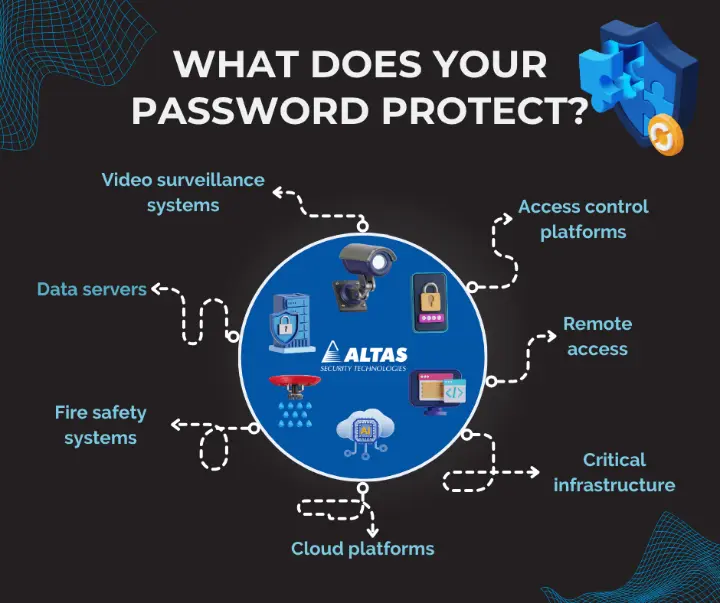
Nowadays, passwords protect more than just email accounts and social media. They protect video surveillance platforms, access control systems, servers, cloud services, and critical infrastructure. This is becoming increasingly relevant in the Baltics, as more and more security systems are managed remotely and connected to the company network.
This is precisely why security integrators are increasingly encountering situations where factory default passwords are still in use in new systems, or the same passwords are used across multiple platforms simultaneously. Many companies still assume that “we’re not interesting to hackers,” but in reality, automated attacks don’t target the most famous companies - they look for the easiest targets.
The reuse of passwords remains a major problem. If a password ends up in a leaked database, attackers will try to use it on other platforms as well. This method, known as credential stuffing, remains one of the most effective attack methods. This means that a password originally used in a less critical system can become a point of entry into a company’s security infrastructure.
Human habits make the situation even worse. Many people still choose passwords that are easy to remember - birthdays, pet names, or simple combinations of symbols. Moreover, much of this information is often publicly available on social media.
In the security technology sector, the consequences of such mistakes are often not just digital - they are physical. A compromised password can mean deactivated perimeter protection, a disabled alarm system, or unauthorized access to the server room. Even more seriously, it could lead to tampering with video recordings or access to government facilities and critical infrastructure sites.
This is precisely why multi-factor authentication, biometric access, Mobile ID solutions, and detailed audit logs are becoming increasingly important in modern security systems. Zero Trust principles are also being adopted more widely - an approach where no user or device is automatically trusted simply because it is on the company’s internal network.
According to Microsoft data, multi-factor authentication can block more than 99% of automated account hacking attempts. It is one of the most effective security improvements that companies can implement without massive investments.
However, technology alone does not solve the problem. Security still starts with basic digital hygiene. Companies must regularly review access rights, change default passwords, and break the habit of using the same password across multiple systems. These days, long passphrases - which are easy for a person to remember but difficult for an attacker to crack - are far more effective than complex combinations of symbols.
It is equally important to use password managers and enable MFA authentication on all critical platforms - especially video surveillance, access control, and remote access systems. In practice, it is precisely these seemingly simple steps that often determine whether an attack will fail or escalate into a serious incident.
Paradoxically, some companies still focus more on acquiring new technologies than on basic security practices. Artificial intelligence, thermal cameras, LiDAR, and biometric solutions are powerful tools, but they cannot compensate for a weak password policy. Sometimes, an entire modern security infrastructure is only as secure as a single administrator’s password.
That is why World Password Day is not just a symbolic date on the calendar. It is an opportunity for companies to take a critical look at their security environment and ask themselves a simple yet uncomfortable question: are our security systems truly secure, or do we simply assume they are?