For years, one persistent myth has circulated in the security industry: “Thermal cameras are expensive.”
And at first glance, it seems true. Place two boxes on a desk — one with a thermal camera inside and one with a standard optical camera — and the difference in unit price can look dramatic.
But experienced system designers and integrators know that comparing box to box is a fundamental mistake. The real cost of any security system only becomes clear when viewed through the lens of the Total Cost of Ownership (TCO).
Let’s take a closer look at Hanwha Vision’s new TNO-C3040T / 50T / 60T / 80T thermal camera series — not from a catalogue perspective, but from the standpoint of real-world project budgets and operational effectiveness.
The TCO Paradox: Less Is More (and Less Is Cheaper)
Imagine a typical scenario: you need to secure a 400-metre perimeter — for example, the fence line of a solar farm or an industrial site.
If you attempt to do this “cost-effectively” using traditional optical cameras, physics quickly becomes your biggest constraint. To maintain full perimeter integrity and eliminate blind spots — even with video analytics — you’ll need to deploy 10 or even 12 camera positions.
At that point, the “cheap” installation starts generating a cascade of hidden costs:
- Passive infrastructure: Instead of a few connection points, you now face extensive civil works — hundreds of metres of trenching for cable ducts and technical conduit routes.
- Network hardware: More cameras require industrial switches with higher port density and increased PoE budgets.
- Installation costs: Each of those 12 cameras requires a pole, foundation, mounting accessories, VMS licences — and most importantly, installer labour hours working at height.
With thermal technology, thanks to long-range detection and AI-powered analytics, the same 400-metre section can often be secured with just two cameras.
Two mounting points. Two connections. Two licences.
When you calculate the full project TCO, thermal often proves to be the more economical option — while also delivering something invaluable: consistent performance in complete darkness, dense fog, or challenging weather conditions.
QVGA Sensor and NETD <20mK: Clean Data for AI
Reducing the number of cameras is only possible if you can trust their range and detection precision.
A key parameter in the new T Series is the NETD (Noise Equivalent Temperature Difference), reduced to 20 millikelvin (mK).
Why does this matter?
For years, 50–60 mK was the market standard. More recently, 30 mK has become common. The difference between 30 mK and 20 mK in thermal imaging is like the difference between headphones that merely reduce background noise and those that create near-total silence.
The sensor is supported by an advanced Image Signal Processor (ISP) that performs intelligent noise reduction. When the background temperature is close to that of the target (low thermal contrast), lower-quality sensors produce image noise — the familiar “thermal snow.”
With low NETD and ISP optimisation, Hanwha Vision’s AI analytics receive clean, stable input. The system doesn’t waste processing power analysing interference — resulting in a dramatic reduction in false alarms.
Range: Physics (DRI) vs. Operational Reality (AI)
Technical specifications often highlight impressive detection ranges based on Johnson’s DRI criteria. For a 60mm lens, physics allows human detection at distances beyond 2 kilometres.
But for a security operator, that information is often meaningless. At 2km, a person appears as a flickering pixel — impossible to reliably classify and operationally useless.
Hanwha Vision therefore distinguishes between:
- Pixel-based detection (pure sensor physics), and
- AI-based detection (real, reliable classification range).
For the 60mm model, the recommended AI-based human classification range is 400 metres (399m precisely) — a safe design buffer ensuring stable performance in real projects.
However, during field testing, we decided to push the system beyond recommended parameters.
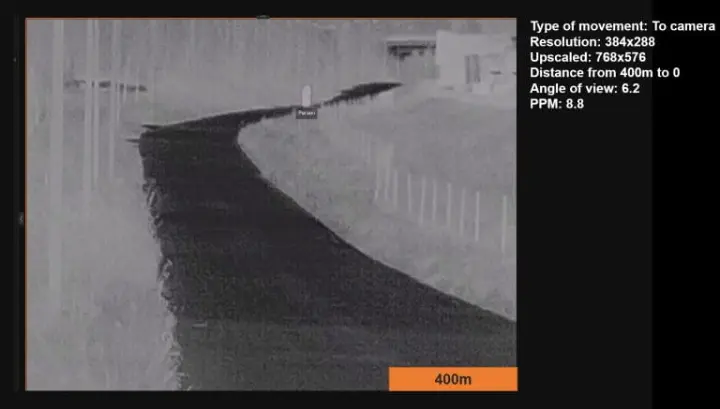
Fig. 1 In a deliberate stress test, the 60mm model successfully classified a person even beyond the recommended parameter of 400 metres. Despite the distance and challenging perspective, the AI correctly identified the object as a “Person.”
For system designers, the takeaway is clear: when selecting between available focal lengths (13mm, 19mm, 35mm, 60mm), focus on the AI detection figures — not just the theoretical sensor range.
Intelligence First: Classification Before Rules
Modern security is no longer about motion detection. It’s about threat detection. In legacy systems, a plastic bag blown by the wind or a fox crossing a protected area would trigger an alarm. The T Series operates differently, following a simple principle:
Classification first. Rule second.
The deep learning algorithm first asks: “Is this a person or a vehicle?”
Only after confirming the object class does the system evaluate rule violations (for example, line crossing or intrusion into a protected zone).
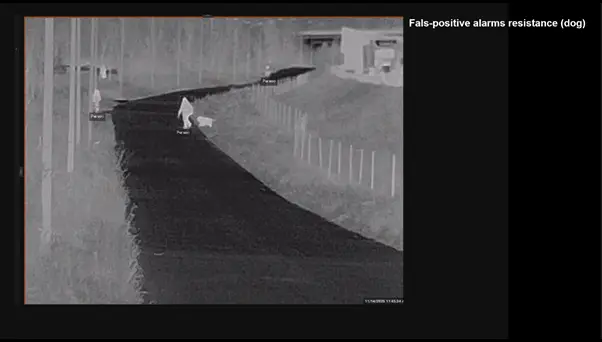
Fig.2 – In testing scenarios, people were correctly detected and classified, while a dog in the same scene was ignored — despite its clear thermal signature — because it did not match the defined object classes.
Installers can further refine detection using Boolean logic, creating rules such as:
“Trigger an alarm only if the object crosses the fence line AND enters the protected zone within 30 seconds.”
This significantly reduces nuisance alarms and operational fatigue.
Design and Cybersecurity: Built for Critical Infrastructure
The new series is also 40% lighter, weighing just 1.7 kg, and features a single-screw (Torx T20) mounting design — reducing installation time at height.
But physical security is only half the equation.
Inside the device is a dedicated Secure Element (SE) — a hardware-based security chip physically isolated from the main processor. It acts as a digital vault, protecting cryptographic keys and sensitive processes.
The random number generator is based on physical entropy (electronic noise), rather than purely mathematical algorithms — making it significantly more resilient to attacks.
As a result, the cameras are certified to FIPS 140-3 and Common Criteria EAL 6+, making them suitable for critical infrastructure environments.
Conclusion: Invest in Intelligence, Not Infrastructure
The Hanwha Vision TNO-C30xx thermal series demonstrates that thermal technology has matured into a practical, commercial standard for perimeter protection.
With ultra-high sensitivity (20mK), advanced AI analytics that minimise false alarms, and a thoughtfully engineered design, these cameras may carry a higher unit price — but at project level, they often represent the most economical and reliable solution.
Instead of investing in kilometres of cabling and forests of poles, it may be wiser to invest in intelligence — technology that sees what others simply cannot.