Over the past decade, the security technology industry has undergone a profound transformation. Artificial intelligence, cloud platforms, automation and cybersecurity have become the dominant themes in discussions about the future of physical security. At first glance, these technologies appear to be the main reason why security projects are becoming increasingly complex. However, the reality in the Baltic market tells a different story.
The core challenge is not AI, cloud technology or even cybersecurity. It is much simpler than that: security systems have evolved into IT systems, while parts of the market still design, procure and maintain them as traditional security installations. This gap is now the primary source of complexity across security projects.
From standalone systems to integrated ecosystems
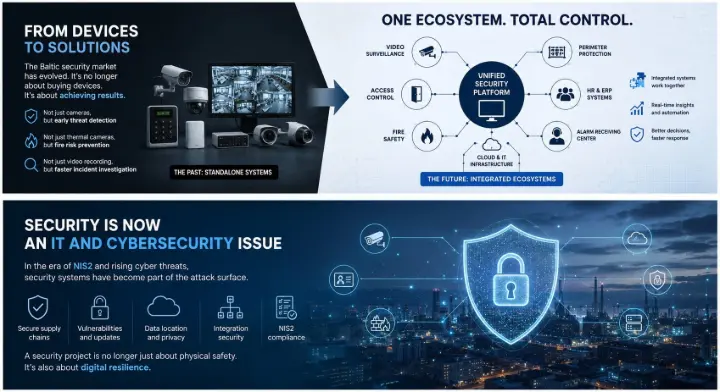
Ten or fifteen years ago, a typical security project consisted of video surveillance, intrusion detection and access control. Each system operated largely independently, and success was measured by relatively simple criteria—cameras recorded, alarms were triggered, and doors opened when authorised. Today, expectations are entirely different.
Organisations expect video surveillance systems to identify incidents automatically, access control platforms to communicate with HR databases, fire safety systems to trigger predefined evacuation scenarios, perimeter sensors to distinguish people from animals, and all of this information to be managed through a single operational platform.
In other words, today's security project is no longer about installing hardware. It is about integrating technologies into a unified ecosystem. And integration has become the most challenging part of every project.
The market no longer buys cameras - it buys outcomes
One of the biggest misconceptions in the security industry is that customers are still buying cameras. In reality, organisations are increasingly purchasing business outcomes rather than individual devices. A seaport does not need 500 cameras; it needs the ability to detect unauthorised intrusions before they become incidents. A manufacturing facility does not need a thermal camera; it needs early fire risk detection that minimises downtime and operational losses. A municipality does not need more video recordings; it needs faster incident investigations. This shift fundamentally changes how projects are designed.
The value no longer lies in a single device, but in how effectively multiple technologies work together to solve a real operational challenge.
AI is not the biggest challenge
Artificial intelligence is undoubtedly reshaping the security industry. Yet, in the Baltic market, AI itself is not the biggest challenge. The real challenge is making AI-generated data useful.
Organisations already produce more security data than they can realistically analyse. AI is accelerating this trend by generating even more information through analytics, object classification and behavioural detection. The companies that will gain a competitive advantage are not those collecting the largest amount of data - they are the ones capable of turning that data into actionable intelligence. This is why the industry is gradually shifting from video-centric management toward metadata-driven operations.
Instead of manually reviewing hours of footage, operators increasingly expect to locate specific events, people or vehicles within seconds.
NIS2 and cybersecurity are changing the rules
Only a few years ago, customers evaluated security systems based primarily on image quality, functionality and price. Today, a different question is becoming increasingly common: "What happens if this system is compromised?"
The implementation of the NIS2 Directive, growing cybersecurity threats and the current geopolitical environment have fundamentally changed how organizations evaluate physical security technologies. Decision-makers are paying much closer attention to supply chain security, manufacturer origin, software vulnerability management, update policies, data sovereignty and secure system integration. As a result, a security project is no longer solely about physical protection. It is equally a cybersecurity project.
The biggest challenge is the skills gap
Ironically, the Baltic security market is not suffering from a lack of technology. It is suffering from a shortage of expertise. Today's security professionals are expected to understand far more than surveillance cameras and access control. They need knowledge of networking, server infrastructure, cloud platforms, cybersecurity, GDPR compliance and complex system integrations.
Professionals with this combination of skills remain scarce across the region. Consequently, technology is advancing much faster than many organizations' ability to implement and maintain it effectively.
A Distributor's Observations on the Baltic Market
Working closely with system integrators, consultants and end users across the Baltics, ALTAS has witnessed a clear shift. The products themselves have not become dramatically more complicated. Customer expectations have.
A decade ago, the conversation usually began with a simple question: "Which camera should we choose?" Today, the discussion is far more strategic:"How will this camera integrate with our VMS, access control platform, cybersecurity policies, NIS2 compliance strategy and future AI roadmap?"
Organizations are increasingly looking for platforms that combine multiple security functions into a single ecosystem, while also prioritizing manufacturers with strong cybersecurity credentials, transparent supply chains and proven reliability in the demanding Baltic climate. This clearly demonstrates that the market is moving away from selecting individual products and toward building secure, scalable and future-ready security infrastructures.
Conclusion
Security projects in the Baltics are becoming more complex, not because there are more cameras, sensors or AI features. They are becoming more complex because security is no longer a standalone system. It has become an integral part of an organisation's IT infrastructure, cybersecurity strategy, operational efficiency and risk management. This transition, from isolated hardware projects to fully integrated security ecosystems, is the defining transformation shaping the Baltic security market today.
For organisations, system integrators and technology providers alike, the implication is clear: future success will not be determined by who offers the most features, but by who delivers the most secure, interoperable and resilient solution.